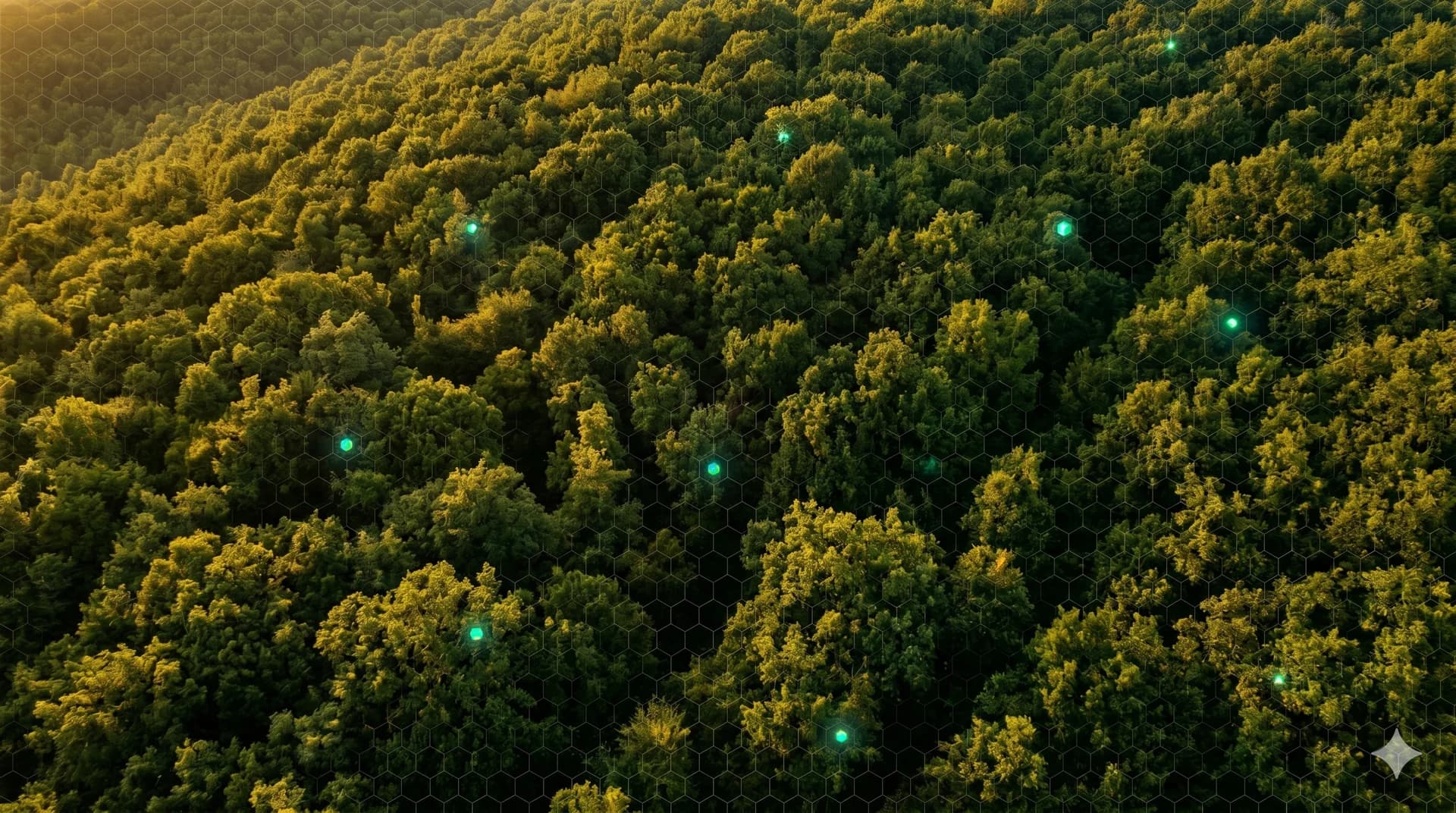
Coorest tokenizes verified carbon offsets as NFTree tokens. Floodlight provides the satellite biomass and sequestration measurements, Chainlink brings them on-chain, and the audit trail follows.
Carbon markets have a credibility problem. Coorest set out to close it by tokenizing verified offsets against satellite-measured biomass instead of self-reported intent.
Carbon markets have a credibility problem. Buyers want to claim offsets against their footprint. Sellers want to monetize their conservation work. Regulators want both sides to be measuring something that actually exists. The gap between aspiration and verification has historically been filled by paper credits, surveyor visits, and trust. None of those have scaled gracefully.
Coorest tokenizes carbon offsets from forested land, regenerative agriculture, and managed green spaces, turning each offset into a blockchain-registered asset its buyers can audit at any time. For that audit chain to mean anything, the underlying carbon measurement had to be airtight, repeatable, and immune to greenwashing claims. Coorest needed an MRV partner that could measure biomass and carbon sequestration across diverse geographies, with the same methodology applied everywhere, and could keep doing it month after month.
Floodlight built that measurement layer. Using satellite imagery from Landsat and Sentinel paired with proprietary AI models for vegetation classification and biomass estimation, Floodlight quantifies above-ground living biomass on a per-asset basis and converts that into a sequestered carbon estimate aligned to IPCC reporting tiers. Spectral profiles of the vegetation at each project location track changes in growth and condition over time, giving Coorest a continuous read on whether each forest, each agricultural plot, each green space is actually sequestering what its credits claim.
A typical Coorest project, like a vegetated parcel near Valencia in Spain, refreshes against new satellite imagery on the same cadence as every other Coorest project in the world. The Normalized Difference Vegetation Index baseline locks in at issuance, and every subsequent overpass updates the record. If the canopy thins because of harvest, fire, or drought stress, the data shows it within days.
Coorest brought this measurement layer on-chain through an integration with Chainlink. Floodlight's biomass and CO₂ flux data flows from the satellite pipeline through Chainlink's decentralized oracle network and into Coorest's smart contracts. When a project's measured carbon sequestration changes, the on-chain record changes with it. NFTree tokens, which represent verified offsets from specific assets, are minted against measurements rather than against intent. Buyers can trace any token they hold back to the exact plot of land it represents and see how that plot has performed since the credit was issued.
The result is an offset market with a verification layer that does not depend on human reporting cycles. Corporate buyers using NFTree tokens to claim against their footprint have a public, third-party record they can point to in disclosures and audits. Auditors examining a buyer's claims do not need to take Coorest's word for anything. They can pull the on-chain history of every token and the satellite measurement history behind it.
For markets the size of voluntary carbon, that kind of continuous measurement is the precondition for scale. Floodlight handles the science. Coorest handles the financial primitives. Chainlink handles the audit trail. None of those layers has to trust the others, which is exactly the property the market has needed for a long time.
See how Floodlight can help your organization achieve similar results with our comprehensive climate risk intelligence platform.
