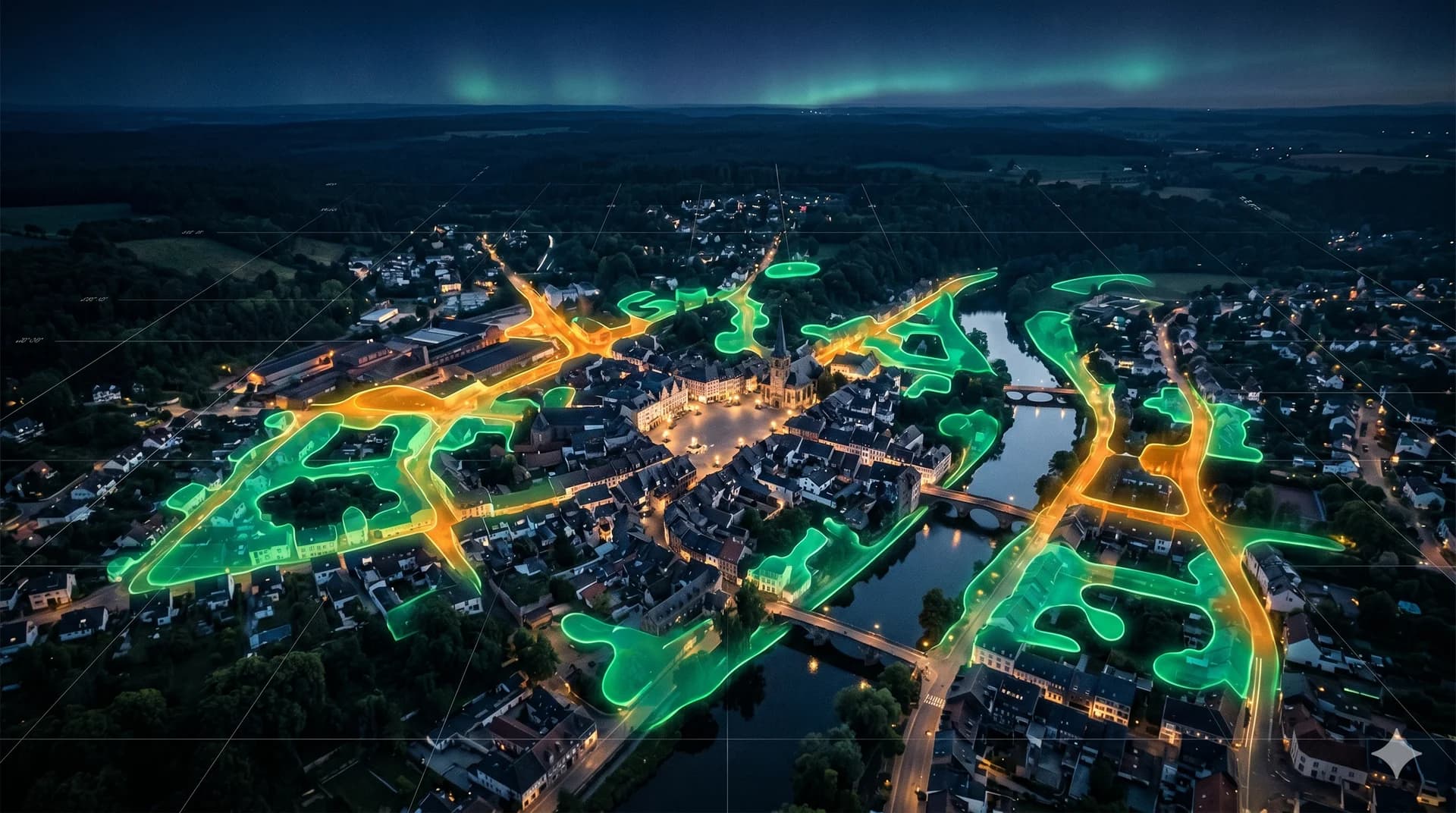
The City of Amstetten partnered with Floodlight to build a satellite-derived emissions baseline aligned with the EU Cities Mission. Floodlight's estimates aligned within 10-15% of internal models and arrived faster.
"Floodlight's rapid and science-based insights gave us confidence to act decisively. Their GHG estimates aligned within 10 to 15% of our internal models, and arrived faster."
The European Union's Cities Mission has set an audacious target: 100 climate-neutral and smart cities by 2030. Eligible cities must demonstrate not just political will but the technical capacity to quantify emissions across buildings, transport, and public infrastructure, and to track those emissions year over year as policy interventions begin to bite. For most cities, that capacity does not exist in-house.
The City of Amstetten in Lower Austria is one of the cities working through the EU Cities Mission and the Climate City Capital Hub framework operated by NetZeroCities. Amstetten's climate team needed to do three things at once. First, establish a credible emissions baseline they could defend in EU funding applications. Second, identify which neighborhoods and which infrastructure categories produced the most emissions. Third, build something they could keep updating over the next five years as carbon abatement policies took effect.
A traditional bottom-up inventory would have taken many months, required contractor support the city did not have budgeted, and produced numbers that were already stale on delivery. Amstetten needed something the climate team could own and rerun internally as conditions changed.
Amstetten partnered with Floodlight to build the baseline using satellite-derived emissions data fused with city-held building registries, traffic telemetry, and energy usage models. Floodlight's pipeline combined readings from Sentinel-5P, GHGSat, and several commercial Earth Observation constellations to monitor CO₂, methane, and NOₓ across the city's footprint. The result was a series of emissions heatmaps at the block level, identifying the top-emitting areas by land use category and showing change over the 2018 to 2023 window.
The accuracy was the critical test. Amstetten's existing internal models, built up from utility records and surveys, gave the team a sense of total city emissions. When Floodlight's satellite-derived numbers came in, they sat within 10 to 15% of those internal figures, and arrived in a fraction of the time. That tight alignment gave the city the confidence to use the satellite data prospectively for monitoring and decision support, not just retrospectively for reporting.
What Amstetten has now is something most climate teams of their size will never afford to build themselves. A scenario modeling layer simulates the emissions impact of specific interventions, from low-emission zones to retrofit programs to electric public transport. A public-facing dashboard surfaces emissions data at the street level, opening the same numbers to citizens that the climate team uses internally. Investment-grade reports aligned to the EU Taxonomy and CSRD make funding applications easier to assemble and harder to challenge.
The data also continues to refresh. As policies roll out and emissions move, Floodlight's continuous monitoring catches the change in near real time. The city no longer has to choose between fast and rigorous.
For Amstetten, the baseline is not a one-time deliverable. It is the foundation under every piece of climate work the city does for the rest of the decade.
"Floodlight's rapid and science-based insights gave us confidence to act decisively. Their GHG estimates aligned within 10 to 15% of our internal models, and arrived faster."
Climate Programs Office, City of Amstetten (May 2025)
See how Floodlight can help your organization achieve similar results with our comprehensive climate risk intelligence platform.
